The Village Apprenticeship Model

At The Village, students do not simply learn skills. They grow into them.
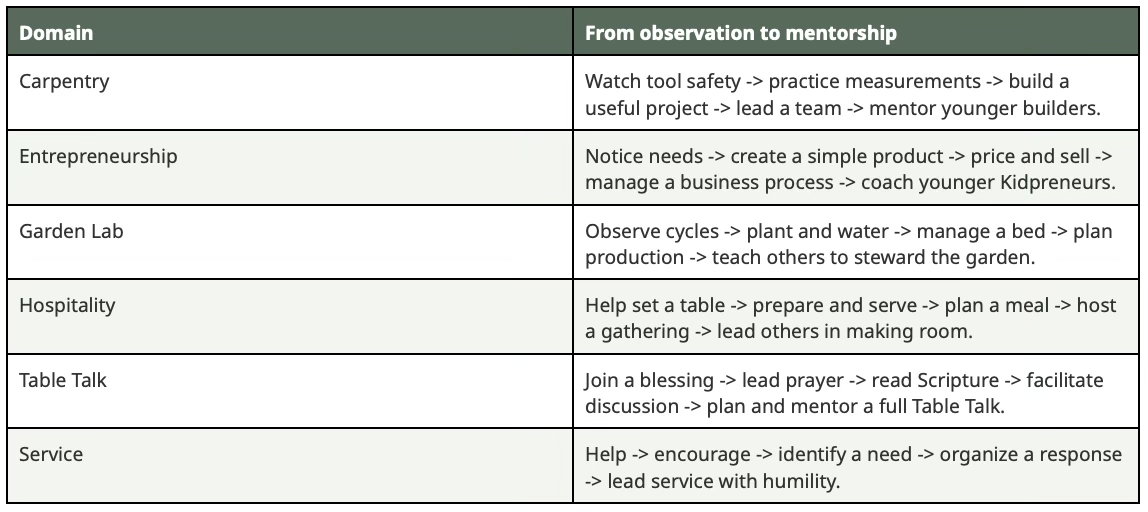
The Village Apprenticeship Model moves students from observation to participation, from participation to competence, and from competence to contribution and mentorship.
Why Apprenticeship?
Long before modern classrooms, people learned meaningful skills beside someone who knew how to do the work. They watched carefully, tried with support, practiced repeatedly, took on real responsibility, produced useful work, and eventually taught others.
That pattern appears throughout The Village: Garden Lab, Faith + Feathers, Building & Carpentry, Mechanics & Systems, Entrepreneurship, Leadership, Hospitality, Preparedness, and service.
A Different Learning Sequence
Not Learn → Test → Forget.
At VCSS our students: Learn → Practice → Contribute → Reflect → Mentor
The Five Stages

Readiness Is More Than A Test Score
Most schools primarily organize students by age, grade, and test performance. The Village also pays attention to responsibility, participation, contribution, judgment, safety, competence, and mentorship. Age still matters - but it is not the only measure of growth.
What Apprenticeship Looks Like Across
The Village Community School of Sarasota


The Deeper Goal
Mastery is not the final goal. Stewardship is. The purpose of learning is not merely to know or perform. It is to use knowledge, skill, influence, and opportunity to serve others well.
Who is your child learning to become as an adult? A student can build a business and manipulate people - or build a business and bless people. A student can learn to speak and seek attention - or communicate clearly so others feel seen and strengthened. Skill and character must grow together.
What Parents May Notice Over Time
Greater willingness to attempt unfamiliar tasks.
More patience with mistakes and revision.
Improved follow-through and responsibility.
Confidence based on competence, not empty praise.
A growing ability to plan, think critically, solve problems, communicate, and work with others.
A shift from “What do I get?” toward “How can I help?” and “Who can I serve?”
Older students becoming examples and mentors rather than merely receiving harder worksheets.